The Stolen Fire
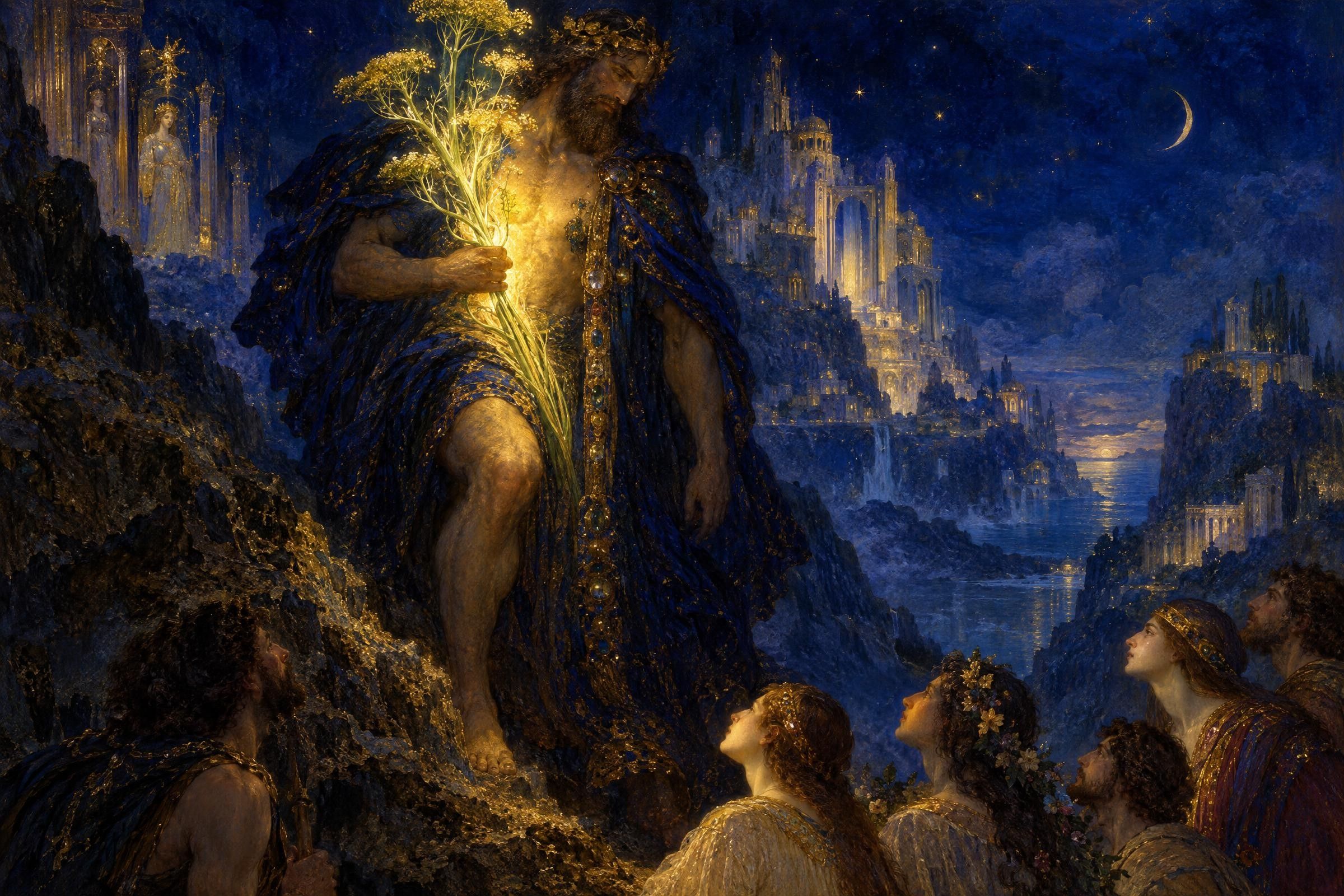
At Mekone, when gods and mortals first sat down to settle what each was owed, Prometheus carved an ox and divided it into two portions. In one he hid the good meat under the ugly stomach. In the other he wrapped the bare bones in glistening fat. Zeus was asked to choose for the gods, and he chose the fat. Ever since, mortals have burned the bones on the altar and kept the meat to eat.
Zeus saw the trick, and he did not forgive it. He could not take back the portion, so he took back something else: he hid fire from mortals. Let them keep their meat, and eat it raw. Let them sit in the dark.
Prometheus’s name means forethought, and he did not act in anger or in haste. He knew what fire was, and he knew what taking it would cost. He weighed it before he moved, and then he went up to where the fire was kept, took a single ember, and hid it in the hollow stalk of a fennel plant, where it could smoulder unseen. He carried it down the mountain in the night, and gave it away.
It was only an ember. But from it came everything. Mortals cooked, and forged, and fired clay, and kept warm through the winter. By the light of it they learned to reckon number, to set words down in writing, to read the stars for the seasons, to tame animals and build ships and mix medicines. The whole of human craft, the old poet said, came from that one stolen coal.
Prometheus had a brother, Epimetheus, whose name means afterthought. He was the kind who takes the gift first and thinks about the price later. Prometheus was the other kind. He had counted the price before he climbed, and when it came due, as it did, he paid it without surprise.
Notice what the fire was not. It was not the lightning, which falls unbidden wherever the sky decides. It was not the grain, which Demeter gave freely to anyone who would plant it. The fire had to be taken — by someone who went up deliberately, at a moment of his choosing, knowing the cost in advance.
The trading concept
The windfall that funds what comes next. A single convex win, small in its origin, can pay for years of growth: new capital for the core, new offerings to the sky, the means to build what did not exist before. One ember is enough, if it is carried home and used.
But the order matters. Forethought comes first. The risk of reaching for the fire — how much can be lost, and how that loss will be borne — is fixed before the attempt, not discovered afterwards. That is the difference between Prometheus and his brother. Both of them receive gifts from the sky. Only one of them has already decided what he is prepared to pay.
Fire is also not free to hold. The cost of keeping exposure to the sky is not a single payment made once at the start; it recurs, and it has to be budgeted for as surely as the ember itself.
Its shadow → The Liver That Grows Back: the fire was carried down in a night, but the price of holding it is paid again every day.
Further reading
- Hesiod, Theogony and Works and Days — the division at Mekone, the hiding of fire, and its theft in a fennel stalk.
- Aeschylus, Prometheus Bound — Prometheus lists the arts that came from fire.
- Plato, Protagoras — the myth of Prometheus and Epimetheus distributing gifts to living things.
- Gustave Moreau, Prometheus (1868), Musée Gustave Moreau, Paris.