The Liver That Grows Back
The shadow ofThe Stolen Fire
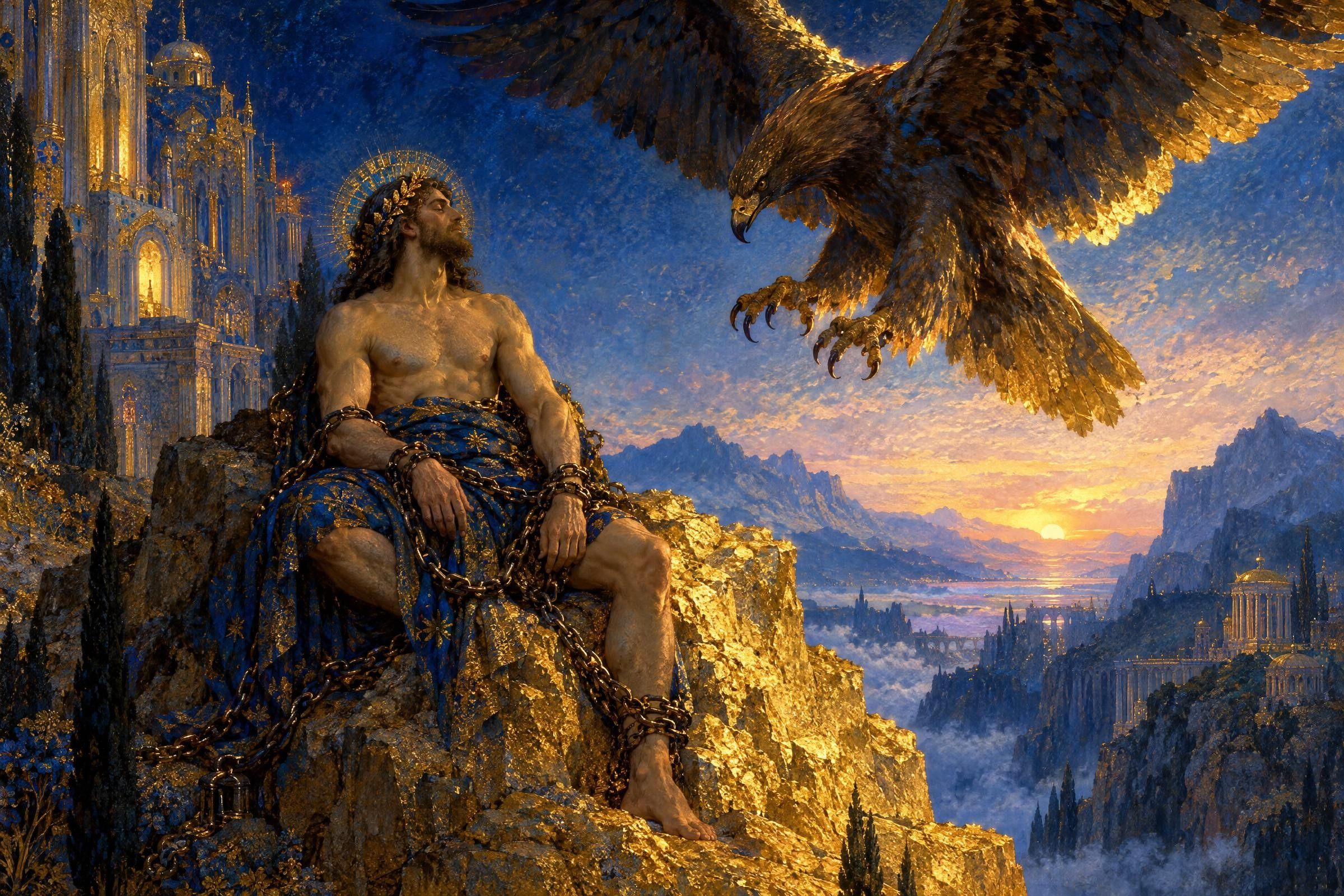
Prometheus knew what the fire would cost before he stole it. His name means forethought, and he had never once acted without first counting the price.
So when Zeus’s servants came for him, he did not run. They carried him to the edge of the world, to a crag in the Caucasus where nothing grew, and Hephaestus, who did not want the work, drove the bronze pins through his chains and into the rock. Then Zeus sent the eagle.
It came at dawn. It tore open the Titan’s side and ate his liver, and all day it fed while the sun crossed over, and at evening it flew away.
And in the night, the liver grew back.
This was the cruelty of the sentence, and it was also its mercy. The wound was never allowed to become a death. Each night Prometheus was made whole again, exactly as much as he had lost, and each dawn the eagle returned to take it. The cost was the same every day. It was never more than he could bear. And it never stopped.
Far below, in the valleys he could not see, men were cooking their meat and working their bronze and gathering at night around the fire he had given them. It went on burning while he paid for it. That was the bargain. The fire was not a gift that had been purchased once and was then owned outright. It was held, and holding it had a price, and the price came due every morning with the light.
He did not curse the eagle. He had known it would come. What he had weighed, long before, was whether the fire was worth a liver a day — and he had judged that it was.
In the end, after long ages, the hero Heracles passed that way and shot the eagle down, and the Titan was freed. But no one on the crag could have said, on any given morning, which morning it would be.
The trading concept
Premium bleed and time decay. Convexity is not bought once. A long option loses a little of its value every day it is held, whether anything happens or not, and a portfolio that keeps exposure to the sky must keep paying for it — the premium spent, the positions that expire worthless, then the next ones bought to replace them. This is the eagle: a steady, regrowing cost that is the price of keeping the fire lit.
The cost is not a flaw in the method; it is the method. What separates a convex philosophy from a reckless one is that the daily loss is known, bounded, and sized so the body always grows back overnight — the bleed never allowed to become a death. Forethought is paid before the fire is taken, not after.
The hardest part is psychological. Day after day the loss is certain and the strike is not, and the temptation to stop paying — to drop the exposure just before the day it would have mattered — never goes away. No one knows which morning the eagle stops coming.
Further reading
- Hesiod, Theogony — Prometheus’s theft, the eagle, and his release by Heracles.
- Aeschylus (attributed), Prometheus Bound — Hephaestus’s reluctant chaining of the Titan, and the eagle foretold.
- Apollodorus, Library, 1.7.1 and 2.5.11 — the Caucasus, the eagle, and Heracles’ arrow.
- Gustave Moreau, Prometheus (1868), Musée Gustave Moreau, Paris.