The Seasons of Persephone
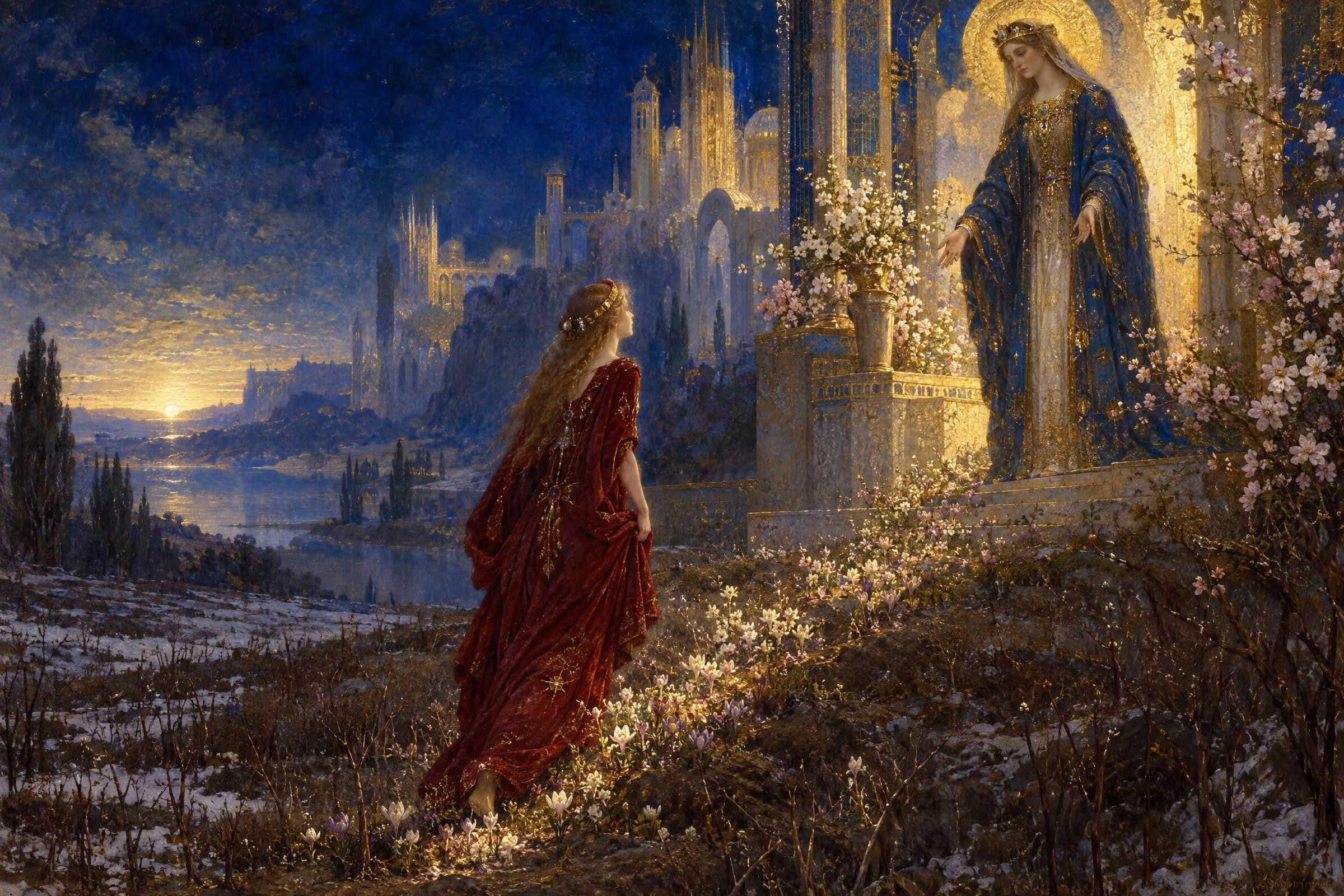
Persephone was Demeter’s daughter, the maiden of the fields. She was gathering flowers in a meadow when the ground opened beneath her, and the lord of the dead carried her down below the earth.
Her mother searched the world for her with a torch in each hand, and while she searched, she let nothing grow. That is another story. This one is about how it ended.
Zeus sent Hermes down to bring the maiden back, and the lord below let her go. But before she left he gave her a pomegranate seed, and she ate it — and anyone who has eaten the food of that place belongs to it, a little, for ever. So the gods struck terms. Persephone would spend two parts of every year above, in the light, with her mother. The third part she would spend below.
And so it has been ever since. Each year the maiden goes down, and the land goes quiet. The fields lie bare; nothing shows above the soil. Anyone looking at them would say they were dead. And each year she comes back up, and the ground answers her. Blossoms open where she walks. The grain rises.
Some say her months below are not the winter at all, but the long dry summer of Greece, when the harvested grain is sealed away in great jars under the ground and the fields are burned brown by the sun. When the rains come in autumn, the grain is brought up out of the dark to be sown — the maiden returning — and the green follows.
Either way, the ground was never dead. The seed was in it the whole time. It was waiting for its season.
The trading concept
Positions have seasons. Every holding in the core goes through stretches when it seems to do nothing, or less than nothing — when the field is bare and anyone looking at it would call it lost. Much of the time that is dormancy, not death. The seed is still in the ground.
The difficulty is that a quiet field and a ruined one look alike on the surface. So the judgement cannot be made by looking at the surface, and it cannot be made in the middle of the winter by someone who is cold. The questions have to be set in advance: what would show that the seed itself has failed, and not just the season? A holding that goes quiet for a third of the year has not broken its bargain. One that has stopped meeting its terms has.
Patience is not the same as hope. The farmer who waits through the bare months knows why he is waiting.
Its shadow → The Year Nothing Grew: the time the goddess withheld the grain altogether, and the whole world went a season without a spring.
Further reading
- Homeric Hymn to Demeter — the taking of Persephone, the pomegranate seed, and the bargain of one third of the year below.
- Ovid, Metamorphoses, Book 5 — the later telling, in which she spends half the year below.
- C. G. Jung and Karl Kerényi, Essays on a Science of Mythology — the Kore essays.