The Keeper of the Hearth
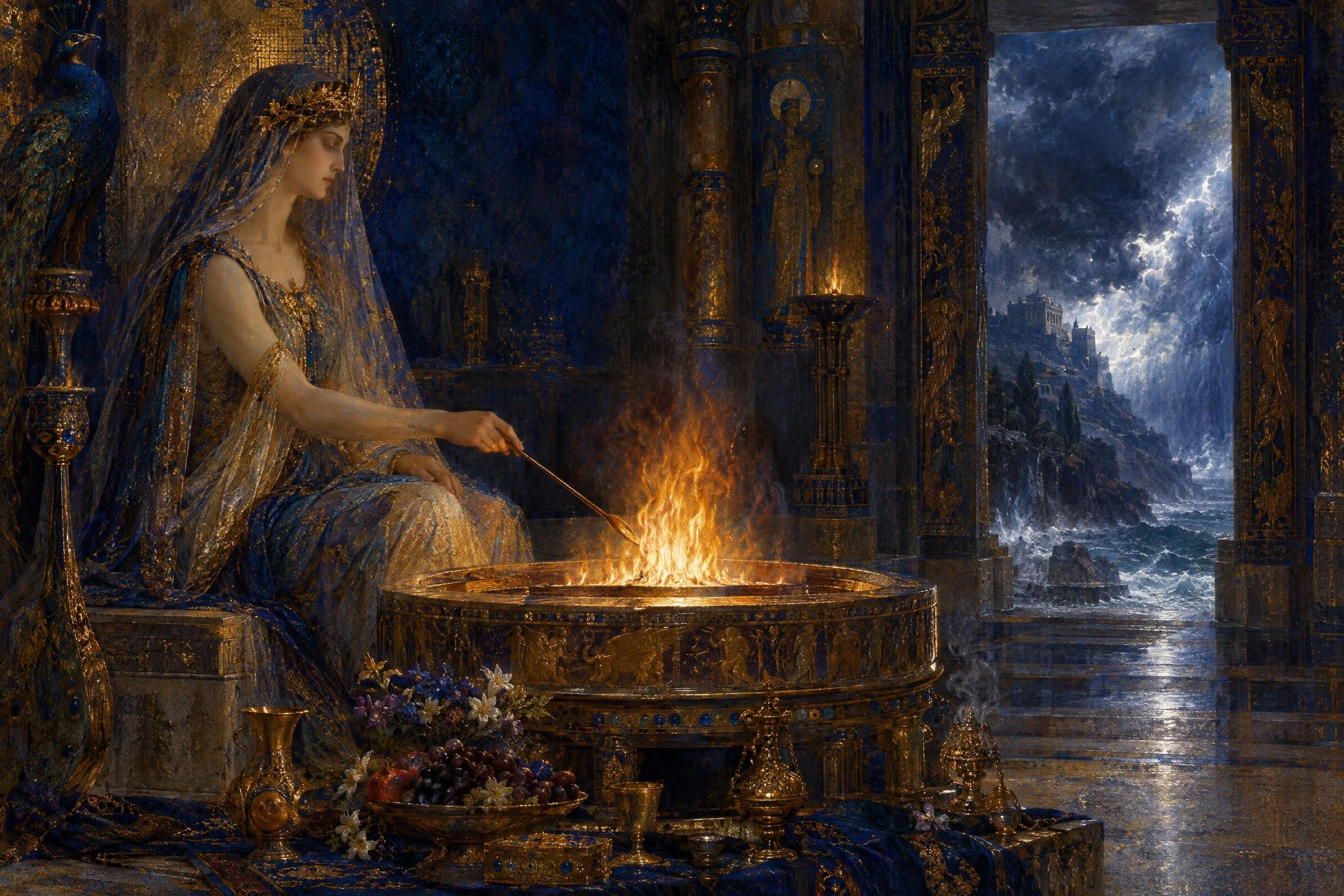
Hestia was the first child born to Kronos and Rhea, and so she was the first her father swallowed. When at last he was forced to give his children back, he brought them up in the reverse of the order he had taken them, and Hestia came out last. So she is called both the eldest and the youngest of the gods: the first to be set aside, and the last to be returned.
When the new gods divided the world, Poseidon and Apollo both came to ask for her hand, and she refused them both. She laid her hand on the head of Zeus and swore she would never marry, never leave, never take a side. Zeus honoured the oath. He gave her no kingdom of her own — no sea, no sky, no field. He gave her the centre of every house instead, and a share of every offering.
So Hestia stayed home. When the other gods rode out to war, or chased their loves, or quarrelled over the fates of heroes, she remained by the round hearth in the middle of the hall, and the fire stayed lit. Her fire had not been stolen from heaven like Prometheus’s, and it had not fallen out of the sky like lightning. It had simply been kept — fed a little every day, banked at night, never allowed to go out.
And at every sacrifice, before the smoke rose to any other god, the first portion went into Hestia’s flame. And when the rites were finished, the last portion went to her too. First and last. Whatever else was given away, the hearth was served before and after.
When the storm came, and the doors were shut against it, the household gathered around her fire. When a new house was founded, or a new city, a coal was carried from the old hearth to light the new one. Nothing started cold, because something had been kept warm.
The trading concept
The reserve. Cash is the least glamorous holding in any portfolio. It does not strike like lightning and it does not bear fruit like the orchard. It simply waits. That is its purpose.
The reserve is paid first and spent last. It is set aside before any sacrifice is made to the sky and before any seed is committed to the earth, and it is the final thing drawn on, not the first. In a drawdown it keeps the household warm while the fields yield nothing; in a crisis it is the coal carried to light a new fire when prices have fallen and others have nothing left to plant with.
Keeping it has a cost: fire that is banked is fire not spreading. The discipline of Hestia is accepting that cost on purpose, because a household whose hearth goes out in the storm does not get to plant in the spring.
Its shadow → The Year Nothing Grew: the long winter when the only warmth in the house is the fire that was kept.
Further reading
- Homeric Hymn to Aphrodite, lines 21–32 — Hestia’s refusal of her suitors and Zeus’s gift of the hearth.
- Homeric Hymn to Hestia (Hymn 29) — the first and last offering.
- Hesiod, Theogony, lines 453–500 — Kronos swallows his children and returns them.