Hermes at the Crossroads
The shadow ofThe Fleece in the Stream and The Division of the Fire
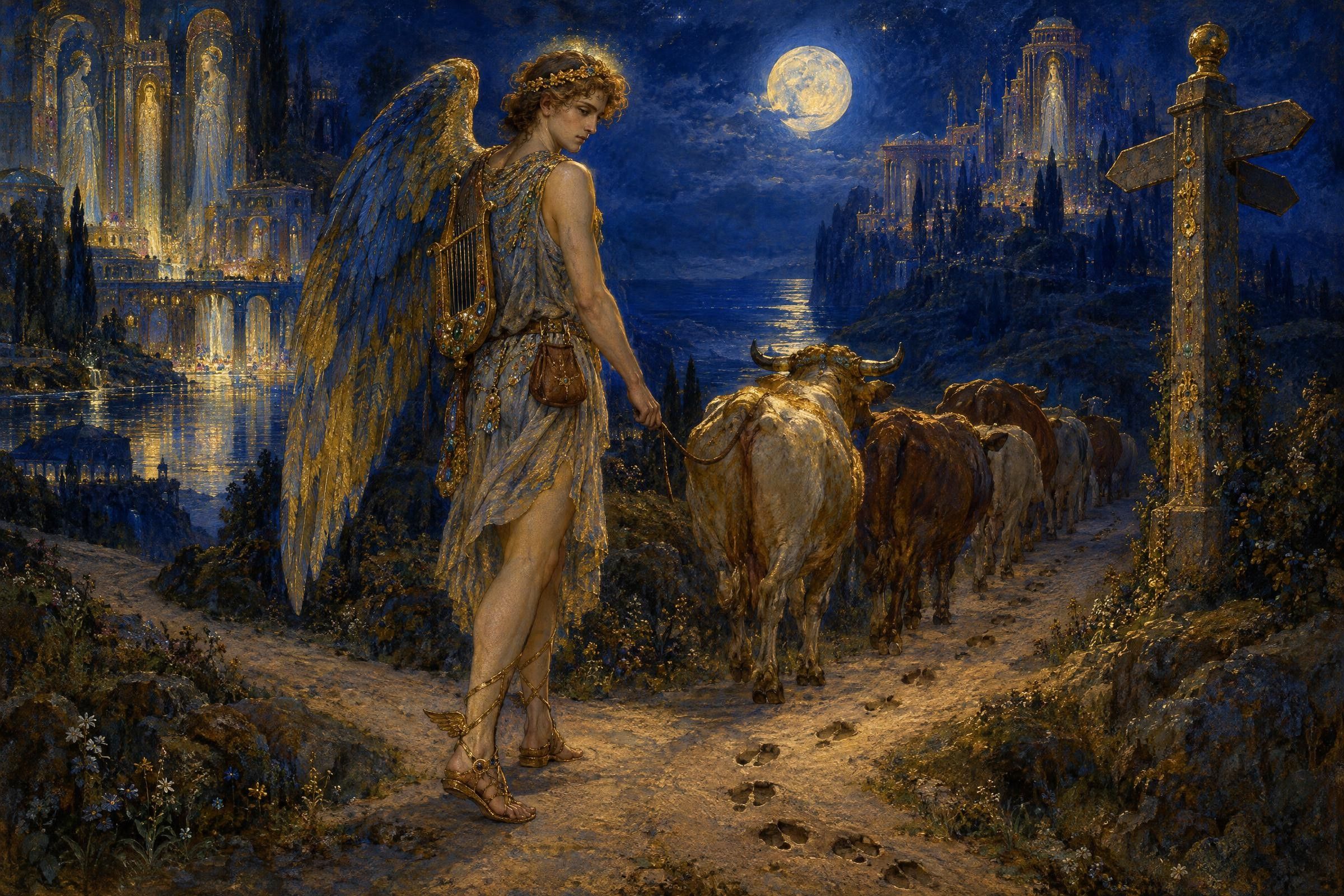
Hermes was born at dawn in a cave on Mount Cyllene, the son of Zeus and the nymph Maia. By noon he had climbed out of his cradle, found a tortoise at the cave’s mouth, and made its shell into the first lyre. By evening he was hungry for meat, and he went looking for his brother Apollo’s cattle.
He found them grazing in the meadows of Pieria, and he cut fifty from the herd. But he did not simply drive them away. He turned them around and made them walk backwards, so that their hoofprints pointed toward the place they had come from. He wove himself sandals of brushwood and twigs, so that his own tracks looked like no one’s. Anyone who followed the trail would be led the wrong way.
Only one old man, working in his vineyard, saw the strange procession pass.
By morning Hermes was back in his cradle, wrapped in his blankets like any newborn, having slipped home through the keyhole like a mist. When Apollo came storming into the cave, the baby looked up at him and said: I was born yesterday. What are cattle?
Apollo carried him before Zeus, and there Hermes swore, with great solemnity, that he had never driven any cattle home. Zeus laughed out loud. He could see exactly what his son had done, and he ordered him to show Apollo where the herd was hidden.
But when Apollo found his cattle, Hermes took up the lyre and began to play, and Apollo had never heard anything like it. He wanted it more than the cattle. So the brothers struck a bargain: the lyre for the herd. Apollo became the god of music, and Hermes became keeper of the flocks — and the herald of the gods, the guide of travellers, the patron of merchants and markets, the giver of lucky finds. And, always, the patron of thieves.
Travellers piled stones for him where roads met. Anything found by chance on the road was his gift. But no one who crossed his crossroads crossed for free.
The trading concept
The cost of crossing. Every movement of capital — out of the garden, into the sky, back again — is carried by Hermes. Execution is his domain, and he is both the god of the windfall and the god of thieves. Nothing crosses without paying him something.
The toll has many names: the spread between what a buyer offers and a seller asks; the slippage between the price you saw and the price you got; commissions and fees; the market that moves away because you are the one moving it. None of it is large on any single crossing. All of it is certain, and it compounds.
And like the cattle’s tracks, it points the wrong way. A backtest that assumes perfect fills shows a trail that leads toward profit; the live account follows it and finds the herd gone. The gap between the two is the difference between the decision as it was made on paper and the price at which it was actually carried out.
Hermes is not an enemy. Without him no fire ever reaches the hearth. But he must be counted honestly, in advance, and crossed deliberately rather than often.
Further reading
- Homeric Hymn to Hermes (Hymn 4) — the birth, the lyre, the theft of the cattle, and the bargain with Apollo.
- Norman O. Brown, Hermes the Thief: The Evolution of a Myth (1947).
- André F. Perold, “The Implementation Shortfall: Paper versus Reality,” Journal of Portfolio Management (1988).