Deucalion's Flood
The shadow ofThe Fleece in the Stream
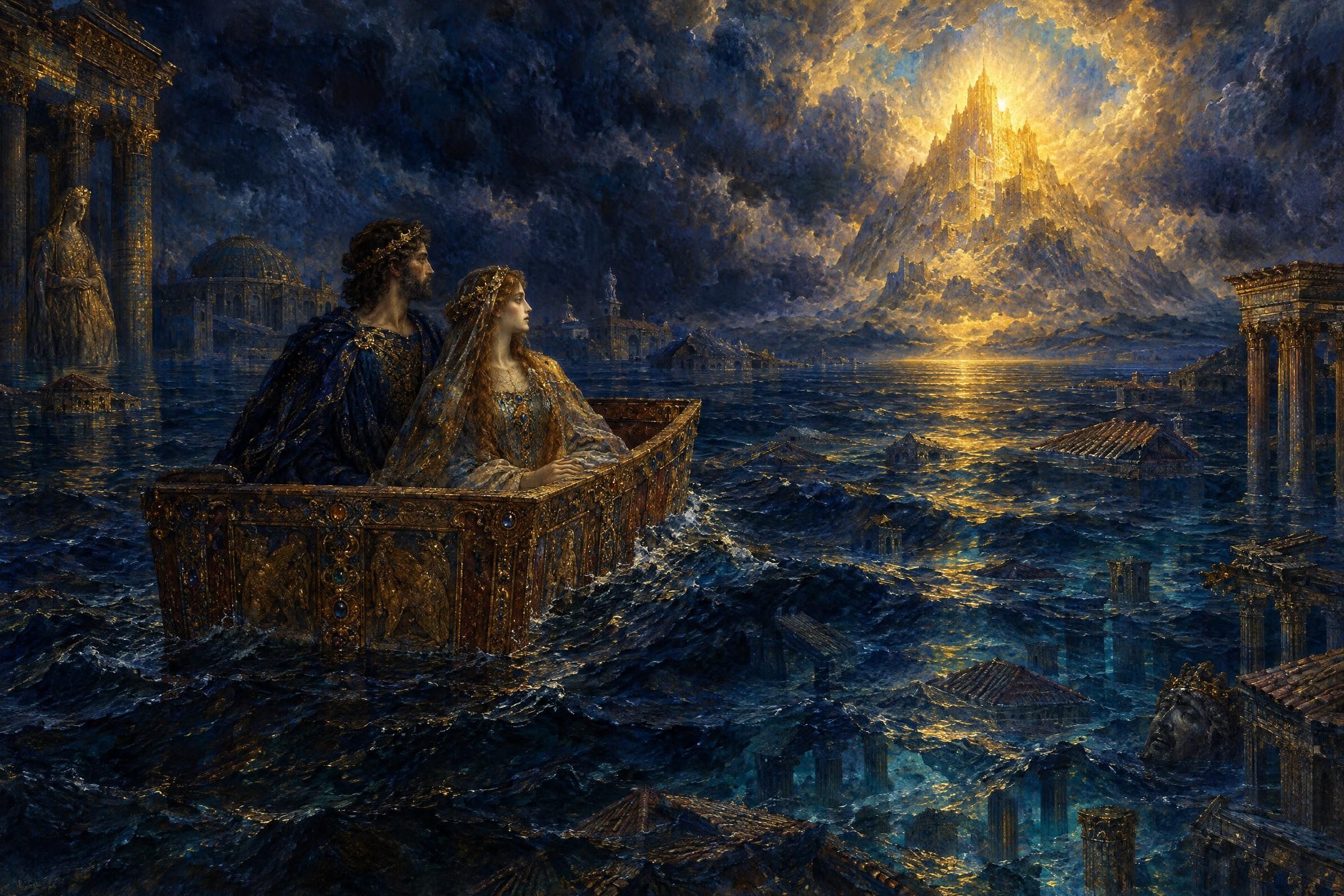
There was an age when men grew careless. They had lived well for a long time, and the long good years had taught them that the world would go on giving. They took what came to them and gave nothing back, and they forgot that what the sky gives, it can also take.
Zeus looked down on them and resolved to wash the earth clean. He shut the north wind in its cave and let the south wind loose, and the clouds gathered, black and heavy, and the rain began.
It did not stop. For nine days and nine nights it fell. The rivers rose over their banks and went on rising. The fields went under first, then the orchards, then the houses, then the walls of the cities. Men climbed to their roofs, then to the hills, then to the mountains, and the water followed them up. Fish swam through the branches of the elms. The whole of Greece became one sea, and the people who had lived so long in plenty were gone with everything they owned.
One man had been warned. Deucalion was the son of Prometheus, whose name means forethought, and his father had told him, long before the first cloud, to build a chest of wood and fill it with what he would need. He had built it in dry weather, when the work looked foolish and the cost of it seemed wasted. When the flood came, he and his wife Pyrrha climbed into it, and it carried them over the drowned world.
On the tenth day the chest came to rest on the heights of Parnassus, and the rain stopped. Deucalion and Pyrrha looked out on a world with no one left in it. They made an offering to Zeus, and went to the shrine of Themis, the goddess of the law, to ask how the world could be peopled again. She told them to throw the bones of their mother over their shoulders as they walked. They understood at last that the mother was the Earth, and her bones were stones. Where Deucalion’s stones fell, men stood up; where Pyrrha’s fell, women. A new race began, from the hard ground, and from the two who had prepared.
The trading concept
Naked premium and the unbounded loss. A pelt laid in the stream with no bank of stones behind it is a short option with nothing bought to cap it. For a long time it looks like the best trade on the river. It keeps all of its gold, because it spends none of it on protection, and season after season the careful shepherd who paid for his bank looks poorer than his neighbour.
The flood does not end that trade by taking a pelt. It takes the village: a loss many times every season’s gold together, and sometimes more than the account itself. The long good years are not evidence against it. They are what it looks like before it arrives.
Deucalion survived because the chest was built in dry weather. Protection bought in calm conditions is cheap and looks wasted; in the flood it cannot be bought at any price. And what comes after is Themis: a world rebuilt by rules set down in advance, from whatever was kept back.
Further reading
- Apollodorus, Library, 1.7.2 — Prometheus warns Deucalion; the chest, the nine days and the landing on Parnassus.
- Ovid, Metamorphoses, Book 1 — the flood, the oracle of Themis and the stones that became people.
- Nassim Nicholas Taleb, Fooled by Randomness and The Black Swan — the seller of insurance against rare events, and ruin.