The One Who Steps Forward
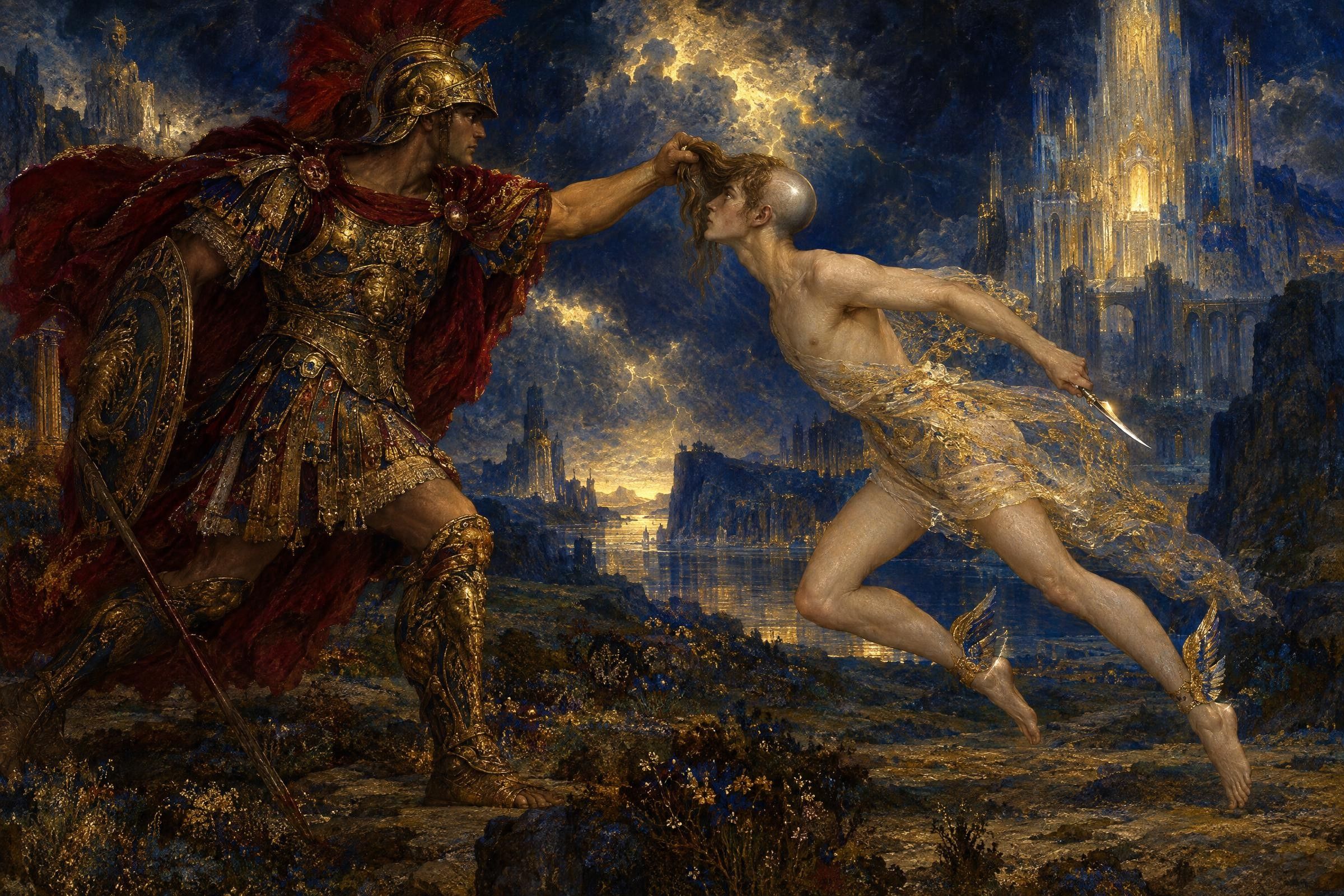
The Romans had a name for Mars that they used when the army marched: Gradivus, he who strides forward. He was not the raging Ares of the Greeks, who fled howling when a mortal wounded him. The Roman Mars was a father of the city, sober and deliberate. He did not decide whether Rome would go out; that was settled first, in council, by those who counted the cost. His part came after. When the decision was made, he was the one who stepped forward and did not hesitate.
In the Greek city of Sicyon there stood a bronze by the sculptor Lysippos, and it showed another god — a young one, whom few had ever seen clearly, because he was always moving. Travellers would stop in front of the statue and question it, and the old verses give its answers.
Who are you? I am Kairos, the moment that masters all things.
Why do you stand on tiptoe? Because I am always running.
Why are there wings on your feet? Because I pass like the wind.
Why does your hair hang down over your face? So that whoever meets me can seize me by it.
And why is the back of your head bald? Because once I have gone by, no one can catch me from behind, however much he wishes he had.
Kairos was not Chronos, the long steady time of the calendar. Kairos was the opening — the single moment when the thing can be done, which arrives without announcement and does not come round again.
So the two belong together. Forethought sets the terms beforehand: how far to go, how much can be lost, what the rule will be. Then the moment arrives, winged and fast, and there is no time left for deliberation — only for the step. The one who has done his counting in advance can reach out and take the forelock. The one who is still counting grabs at the bald back of a god already gone.
And there is a third figure, the one who never steps at all. He has no losses to speak of. He also has nothing in the field when the sky breaks open, because lightning cannot strike an empty field.
The trading concept
The entry. Every convex profit exists because someone acted — placed the trade, held the option, stood exposed when the event arrived. The philosophy can be flawless and the analysis correct, and without the step forward none of it pays. The strike only rewards those who are actually standing in its path.
The discipline has two halves, and the order matters. The risk is fixed first, calmly and in advance, so that when the opportunity appears there is nothing left to decide. Then the entry is taken without hesitation, because opportunities of this kind do not wait. A trader who re-deliberates at the moment of action is always late; a trader who acts without having fixed the risk first is not Gradivus at all, but the reckless brother who takes the gift and asks the price afterwards.
Its shadow → The Wrath of Achilles: the same readiness to step forward, turned by an unfair loss into the urge to strike back and win it all again.
Further reading
- Posidippus, Greek Anthology 16.275, and Callistratus, Descriptions 6 — Lysippos’s bronze Kairos at Sicyon, the god seized by the forelock; later reliefs at Trogir and Torcello.
- Homer, Iliad, Book 5 — Greek Ares wounded and fleeing, the god the Roman Mars is not.
- Hesiod, Works and Days — Prometheus, Epimetheus, and the gift taken without forethought.
- Nassim Nicholas Taleb, Antifragile — optionality: only those exposed to an outcome can benefit from it.