The Gift of Grain
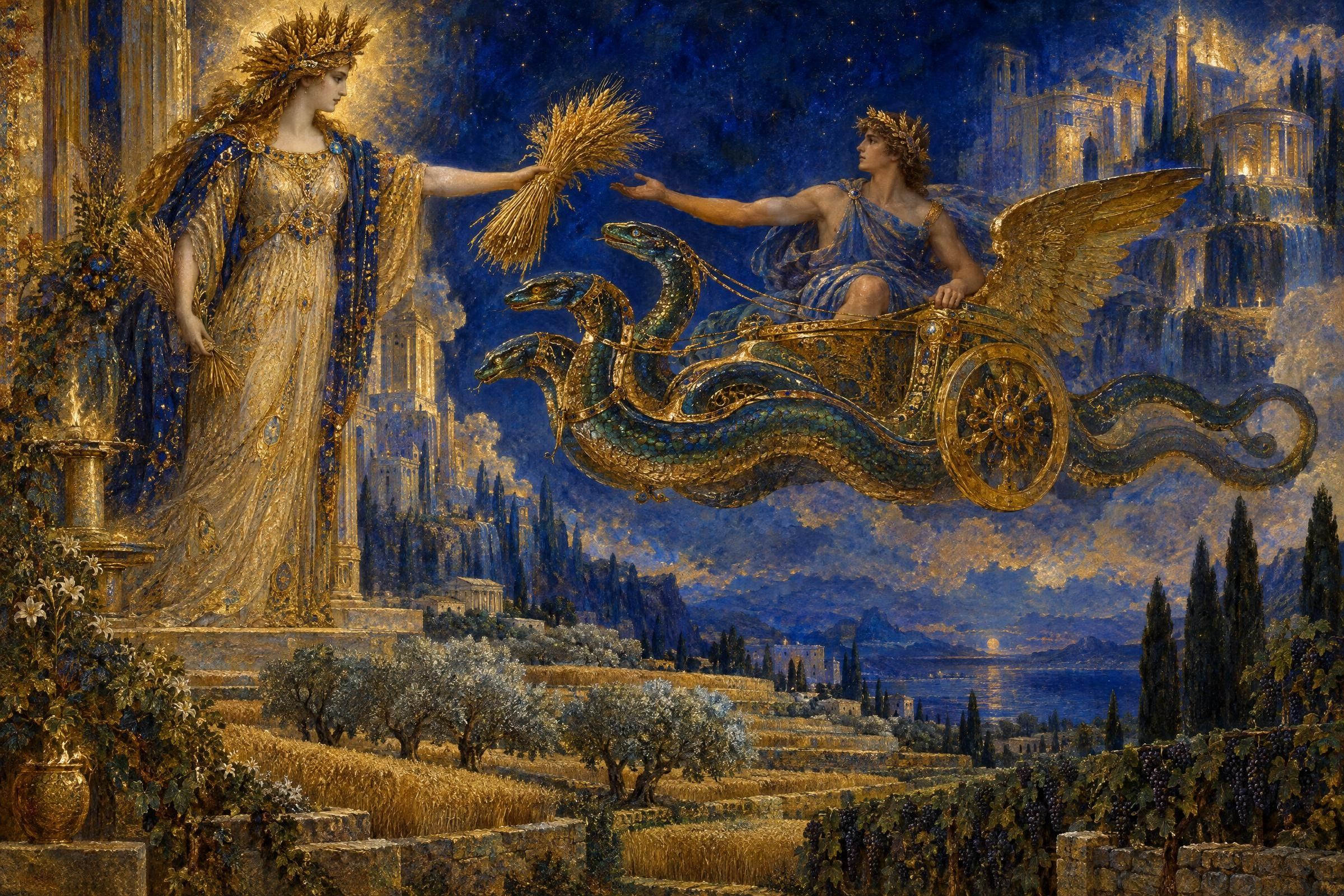
Fire came to mortals by theft. Prometheus carried it down in a hollow stalk, and everyone paid for it — the Titan on his rock, and mortals in the troubles that followed. Grain came another way. Nobody stole it. It was given.
Demeter, the grain mother, came to Eleusis in her wandering, and the people there took her in. In return she did not give them gold, or a weapon, or a single miracle. She gave them a way of living. She took Triptolemus, the young prince of the house, and showed him how to break the ground, how to sow, how to wait, and how to reap. Then she gave him a chariot drawn by winged serpents and a store of seed, and sent him out over the whole world.
He flew over plains and river valleys and far coasts, scattering grain as he went, and wherever it fell people learned what he had learned: that a handful kept back from the harvest and put into the ground comes up many times over, and that the harvest of this year is the seed of the next.
Grain was not the only gift the earth held. Athena gave the olive, which grows slowly on stony hillsides and bears for a hundred years. Dionysus gave the vine, which clings to the slopes and ripens late, in the heat. Grain, olive and vine: three crops, sown and harvested in different seasons, with different roots going down to different depths.
The farmers of the old Mediterranean kept all three, and they knew why. A late frost might blacken the vines and leave the olives untouched. A dry spring might thin the wheat while the deep-rooted trees drank from water far below. A storm could ruin a harvest. It was very rare for one storm to ruin all three.
So they planted, and waited, and planted again. None of it was fast, and none of it was glorious. But it was theirs, freely given, and it grew.
The trading concept
The core portfolio. The sky gives the rare, sudden strike. The earth gives something else: slow, steady growth that compounds. Each year’s harvest supplies the next year’s seed, and over a long enough time that patient return adds up to the bulk of what is built. Unlike the fire, it does not need to be stolen at a price. It is available to anyone willing to plant and wait.
Diversification is the triad. Holdings that respond to different weather — different seasons, different roots — do not all fail together. The point is not that any one crop is safe. It is that the field as a whole survives a storm that would have destroyed a single crop. This is the large, safe core of the barbell: the land that feeds the household while a small part of the capital stands open to the sky.
Its shadow → The Year Nothing Grew: there are seasons when the goddess withholds her gift, and every crop in the field goes quiet at once.
Further reading
- Homeric Hymn to Demeter — Demeter at Eleusis and her gift to its princes.
- Apollodorus, Library, 1.5.2 — Triptolemus and the chariot of winged serpents.
- Ovid, Metamorphoses, Book 5 — Triptolemus sent out to sow the world.
- Colin Renfrew, The Emergence of Civilisation (1972) — the “Mediterranean triad” of grain, olive and vine.
- Harry Markowitz, “Portfolio Selection”, Journal of Finance (1952) — the founding statement of modern portfolio theory: diversification made mathematical.