Erysichthon's Hunger
The shadow ofThe Trees That Bear
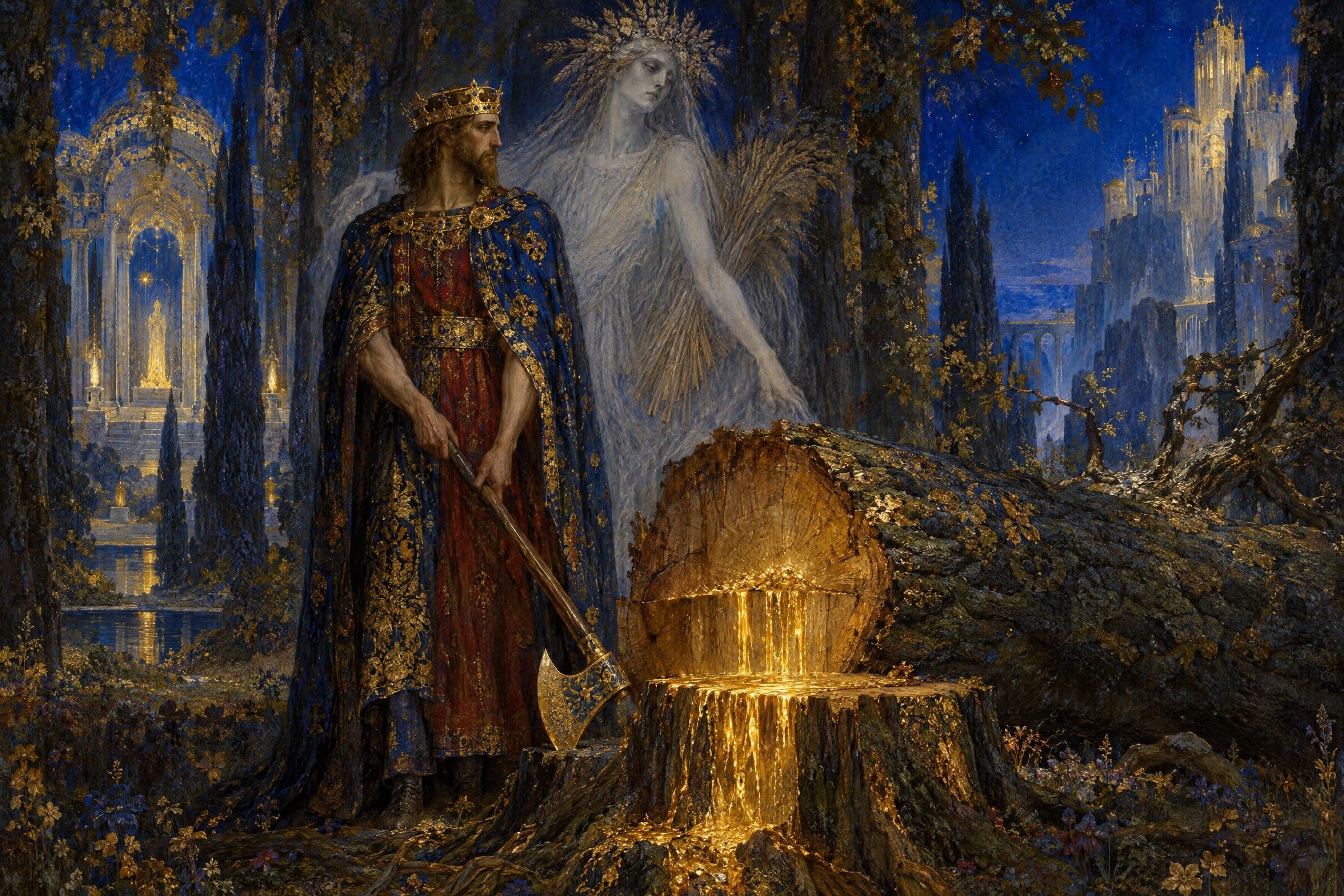
In Thessaly there was a grove sacred to Demeter, so thick with trees that an arrow could hardly pass through it. At its heart stood an oak older than any house in the land, hung with garlands and the tokens of prayers answered. The nymphs of the grove danced around its trunk.
Erysichthon, son of the king, wanted timber for a banquet hall. He came to the grove with his men and their axes.
Demeter came to meet him in the shape of her own priestess, and spoke to him gently. Child, turn back. These trees are the goddess’s. Do not cut them. He lifted his axe toward her and told her to get out of his way — he needed a roof over his feasts.
So the oak was felled. At the first stroke the tree shuddered and groaned; where the blade bit, the bark ran red, as if the wood were bleeding. His men stopped. He did not. He struck until the old tree came down, and the grove went silent.
Then the goddess showed herself as she was, and she did not strike him with lightning or with plague. She gave him what he had shown he wanted. She gave him hunger.
Famine came to him in the night, a gaunt figure from the frozen edge of the world, and breathed herself into him while he slept. He woke starving. He ate, and the eating made him hungrier. He called for the herds, the flocks, the granaries; he ate the cattle meant for the altar and the horse meant for the race. Whatever he took went into him and was gone, and the emptiness only grew. The feasting hall was never built. There was nothing left to feast on.
When the household was bare he sold his own daughter for food, again and again. When there was no one left to sell, he began to eat his own body. And so the man who had cut down the tree that took a hundred years to grow for the sake of one evening’s banquet consumed himself, a mouthful at a time, and was never full.
The trading concept
Overtrading. The long-term holdings in the core are the grove: slow-growing, compounding, bearing fruit year after year because they are left standing. They look like idle timber to anyone who wants action tonight.
Cut them to fund a burst of short-term activity, and the first cut rarely feels like a mistake. But trading has a way of feeding its own hunger. Each trade costs something to make; each result, win or loss, calls for the next one; the activity begins to feel like the work itself. Turnover rises, and returns do not. The churn eats the costs, the costs eat the capital, and eventually it eats the very holdings that were supposed to be the source of wealth.
The curse of Erysichthon is that the hunger is not satisfied by feeding it. More activity is not more yield. The sacred grove is protected by a rule written in advance — these trees are not for cutting — because by the time the hunger arrives, it will always have a good reason.
Further reading
- Ovid, Metamorphoses, Book 8 — Erysichthon, the bleeding oak, Famine, and his shape-changing daughter (named Mestra in the Hesiodic Catalogue of Women).
- Callimachus, Hymn to Demeter (Hymn 6) — the grove, the goddess disguised as her priestess, and the insatiable hunger.
- Brad M. Barber and Terrance Odean, “Trading Is Hazardous to Your Wealth: The Common Stock Investment Performance of Individual Investors,” Journal of Finance (2000).